Study confirms:
Effects of METAVITAL MNLS technology on cultured neuronal and inflammation-mediating cells
Unwanted environmental influences such as electrosmog, industrial chemicals, xenobiotics, air pollution from particulate matter, UV radiation and much more can lead to an increased formation of reactive oxygen species (ROS) or radicals in the body, which overtax the body's own antioxidant enzyme systems. The result is oxidative stress, which can damage cells and organs. In the nervous system, for example, damage to lipids, proteins and DNA can lead to neuronal dysfunction and even neurodegenerative and neuroinflammatory processes.
Oxidative damage in the mitochondria, amyloid beta and tau deposits and inflammatory processes are associated with dementia. Multidimensional non-linear systems (MNLS) are recognized and applied analysis and balancing systems in complementary medicine, which restore the energetic and functional status of an organism. The measurement is based on biophotons. MNLS systems are not yet recognized in conventional medicine. In this animal-free cell biology study, the effects of an MNLS-based system from METAVITAL were investigated at the cellular level. Based on the knowledge of neurodegeneration and neuroinflammation, both neuronal and inflammation-mediating cells were used. The investigations carried out are internationally accepted test procedures in preclinical research.
Cell cultures
The investigations were carried out with two different organ-specific cell cultures:

(1)
Human neuronal cells (cell line SH-SY5Y, ACC 209; DSMZ, Braunschweig), which are used in current dementia research
(2)
Human promyelocytes (cell line HL-60, ACC 3; DSMZ, Braunschweig), which were differentiated into inflammation-mediating cells (functional neutrophils).
Through an oxidative or respiratory burst, these cells can form superoxide anion radicals locally in the tissue and thus contribute to tissue destruction or an inflammatory process. The cells of both cell lines were routinely grown as mass cultures in their special culture media in an incubator in a standardized atmosphere and seeded into the corresponding new culture vessels for the tests.
Test product, exposure time and test arrangement
An MNLS-based system from METAVITAL GmbH was made available to us for the duration of the investigations. This was used in accordance with the manufacturer's instructions, with the biophoton trigger sensor consisting of a light intensity sensor and infrared light source positioned 40 mm below the cell culture dishes or bottles (Fig. 1). The exposure was always carried out with 100 % PWM. The signal strength was between 86 % and 91 % and the reflectance of the signal was always in the green range. The control cells and the treated cells were cultivated in separate mini-incubators at 37 °C in a pH-stable culture medium. The two incubators were placed approximately 10 meters apart and separated by several house walls. In preliminary cell culture experiments with different exposure times to the infrared light source, we were able to determine a duration of 60 min for an optimal cell effect.
Longer exposure times no longer changed the result.

Fig. 1: Experimental set-up with a cell culture multi-plate 40 mm above the biophoton trigger sensor. This arrangement was located in a mini-incubator at a temperature of 37 °C using a pH-stable culture medium. The other devices of the MNLS-based system, such as the METAVITAL box and the notebook with the appropriate software to control the system, are not shown. The wells with the cells are marked by the red culture medium.
Tests performed and results
No further detailed scientific description of the test procedures is provided, as this would impair the general comprehensibility of the test report. If required, this data can of course be supplied at a later date.
4.1 Cell vitality
Cell vitality and cell metabolism are fundamental for the function and adaptability of tissues: Metabolism provides the energy and building materials necessary for growth, differentiation, repair and signaling. This promotes cell vitality and cell health.
The neuronal cells were seeded into the wells of a multiwell culture plate and, after 24 hours of settling, spreading and resumption of cell metabolism, treated with the MNLS-based system for 60 minutes and then cultured for a further 24 hours. The control cells remained untreated. The activity of the mitochondrial dehydrogenases was then quantitatively determined using an enzyme test (XTT test). Three independent experiments were carried out, each with several replicates.
Result: A single exposure to the METAVITAL MNLS-based system improved neuronal cell viability by 10.1 ± 3.3 % (mean ± standard deviation) compared to the untreated control. This difference to the control was statistically significant (p ≤ 0.05; two-sided Wilcoxon-Mann-Whitney rank sum test) and demonstrates the potential of the MNLS-based system, as the observed effect can possibly be significantly enhanced by several consecutive exposures.
4.2 Regeneration
Cell regeneration is a fundamental biological process that enables organisms to replace damaged or dead cells and thus maintain homeostasis. By promoting regeneration, the integrity and functionality of the affected tissue area can be restored earlier.
In this test, the colonization of a cell-free space after 15 hours was determined as a measure of the cell regenerative potential when treated with the MNLS system for one hour directly at the beginning of the regeneration phase. The control cells remained untreated. At the end of the experiment, the remaining uncolonized area was documented using micro-photo series and evaluated using special AI software. Three independent experiments were carried out, each with several replicates.
Result: The residual area at the end of the experiment was only 9.4 ± 2.3 % of the total area for the cells treated with the MNLS-based system and 15.6 ± 2.7 % of the total area for the untreated cells (mean values ± standard deviations). The difference was statistically significant (p ≤ 0.01; two-sided Wilcoxon-Mann-Whitney rank sum test) and illustrates the stimulation of cell regeneration by the single treatment with the MNLS-based system from METAVITAL (Fig. 2). This allows smaller nerve lesions to heal more quickly.
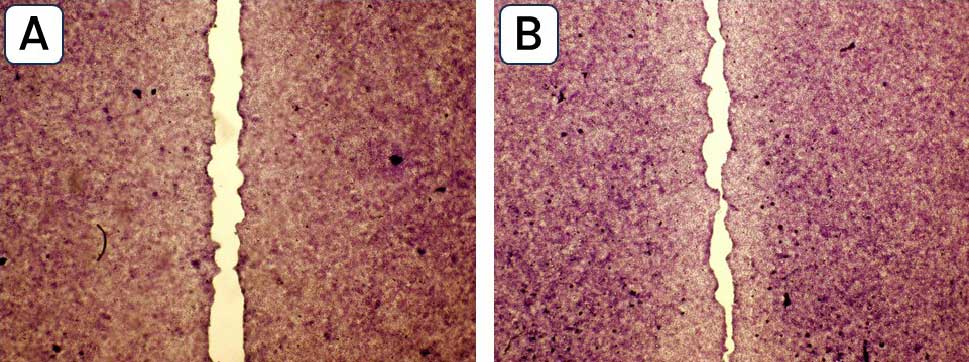
Fig. 2: Photomicrograph documentation of the cell-free space remaining after 15 hours in the untreated control cells (A) compared to the cells that were treated with the METAVITAL MNLS system for one hour at the beginning of the regeneration phase (B).
4.3 Environmental oxidative stress
After a 24-hour exposure time to different concentrations of hydrogen peroxide (0.5 to 2 mM) in the culture medium, the viability of the cells was examined with and without an initial one-hour treatment with the MNLS-based system from METAVITAL. This simulated a situation that permanently affects our organism due to environmental influences and can lead to undesirable oxidative stress with the resulting health consequences. Viability was measured using an enzymatic test. Three independent tests were carried out, each with several replicates.
Result: As expected, the viability of the cells decreased with increasing hydrogen peroxide concentration in the culture medium. Nevertheless, at all concentrations, the viability of the cells treated only once with the MNLS-based system was significantly better than that of the untreated cells. At the highest concentration, the protective effect of the MNLS-based system on cell viability was greatest at 61.2 ± 5.9 % compared to the untreated control at only 41.6 ± 4.3 % (mean values ± standard deviations in each case). The difference was statistically significant (p ≤ 0.01; two-sided Wilcoxon-Mann-Whitney rank sum test).
4.4 Endogenous radical formation in tissue
In most mammals, neutrophils are the most common type of granulocyte, i.e. a specific type of white blood cell. They play a role as phagocytes (= scavenger cells) in the blood as a cellular defense against foreign microbial germs and – after migration into the tissue – as inflammation-mediating cells.
An oxidative burst of the cells after stimulation can lead to increased formation of reactive radicals, which kill the foreign germs in the blood and then remove them by phagocytosis, but can trigger inflammatory processes in the tissue.
The promyelocytes were differentiated into functional neutrophils by adding 1.5 % dimethyl sulphoxide for 6 days. On the last two days of differentiation, the cells were treated for one hour each with the MNLS-based system from METAVITAL. The control cells remained untreated. Afterwards, their inactivation with and without exposure was quantitatively determined by cleavage of a dye by the radicals formed in the oxidative burst. Four independent experiments were carried out, each with several replicates.
Result: Treatment with the MNLS-based system from METAVITAL resulted in a stronger and statistically significant reduction in endogenous radical formation in the tissue by 18.8 ± 4.4 % compared to the untreated controls (mean values ± standard deviations; p ≤ 0.01; two-sided Wilcoxon-Mann-Whitney rank sum test). This is characteristic of the inhibition of inflammatory processes.
Oxidative stress from the environment and induction of a neurodegenerative process: protective effect of treatment with the MNLS-based system from METAVITAL
The survivability of the cultured neuronal cells after an artificially induced oxidative stress in the environment of the cells was continuously recorded under the microscope. For this purpose, reactive oxygen species (ROS) were added to the culture medium. An untreated culture served as a direct comparison.
One image was recorded in 30 seconds and later every second image was taken from the series and put together to form a time-lapse video clip. This means that one image per minute was used for the clip. When playing back 25 images per second, this means a time lapse by a factor of 1,500 x, i.e. one second in the time-lapse video corresponds to 25 minutes in reality. The same procedure was used with the untreated control culture.
It is clearly recognizable that exposure to the MNLS-based system leads to a protective effect against the ROS and that far fewer neuronal cells than in the untreated control initially round off, detach from the culture dish and eventually die.
These time-lapse video clips thus document the protective effect of METAVITAL’s MNLS-based system in dynamic form. This effect can result in reduced oxidative stress and thus also a reduction in neurodegenerative processes in the body.
Conclusion
Oxidative stress plays a central role in the damage of nerve cells and the development of many neurological diseases. As shown in these studies at the cellular level, the MNLS-based system from METAVITAL has beneficial properties that can counteract neurodegeneration and neuroinflammation and the associated functional disorders, even in a complex whole organism.
Responsible for the scientific accuracy of the tests performed and the content of the test report.

Materials
Effects of METAVITAL MNLS technology on cultured neuronal and inflammation-mediating cells

Test report
dartSCIENTIFIC
Dießen am Ammersee, 12.01.2026